How Lutheran Family Service’s EMDR and Peer Support Offer Different Paths To Recovery
Post-traumatic stress disorder (PTSD) affects people from every walk of life—survivors of violence, veterans, first responders, children who’ve experienced chronic adversity, and anyone who has lived through overwhelming events. At Lutheran Family Services (LFS), trauma-informed care is at the heart of our behavioral health work. Two of the different tools we use are Eye Movement Desensitization and Reprocessing (EMDR) and peer support, each to help people stabilize, heal, and rebuild their lives.
PTSD: Why Trauma Gets “Stuck” in the Brain
When someone experiences trauma, the brain shifts into survival mode. The emotional center becomes highly active, while the reasoning part temporarily shuts down. As Birgit Schlechte, the EMDR supervisor at LFS, explained, during trauma “the neocortex… is offline, because we’re in fight or flight.”
This means the brain stores the memory in a raw, unprocessed form—full of sensory details, fear, and physical reactions. Everyday sights, sounds, or smells can later trigger that same fear response. Schlechte said, “A victim may encounter a smell that is connected to the traumatic incident, and the brain puts her right where she was.”
An example that she used was the smell of a flower that was experienced during a traumatic event, such as a rape or assault, could be smelled years later and trigger a PTSD episode.
This is the core of PTSD: the past intrudes into the present.
How EMDR Helps the Brain Heal
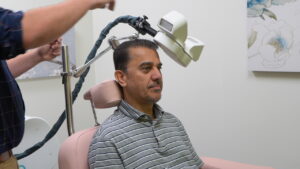
EMDR uses bilateral stimulation—such as guided eye movements or tapping on alternating sides of the body—to help the brain reprocess traumatic memories. This allows the memory to move from the emotional center of the brain to the reasoning center, where it can be understood and integrated.
According to Schlechte, “The memory that’s frozen in time gets moved from that part of the brain where it is stored over the hippocampal bridge to the neocortex, where the neocortex can deal with it.”
As this happens, people often experience a shift in the beliefs they hold about themselves or traumatic events. Shame, guilt, or self-blame begin to loosen. Schlechte said that survivors may move from thoughts like ‘It was my fault’ to ‘I did the best I could’ or ‘I’m safe now.’
LFS has offered EMDR since around 2012 and now provides it across multiple locations for both adults and children. Schlechte supervises LFS staff who are trained in EMDR and routinely staffs their clients with PTSD.
The Role of Peer Support: Walking with Clients
While EMDR addresses the neurological impact of trauma, peer support addresses the human impact—the isolation, the fear of being misunderstood, and the belief that healing is out of reach.
Peer Support Specialists at LFS use their lived experience to build trust, stabilize crises, and help clients navigate complex systems. As Angela Hamilton, a veteran with over 8 years in the military, and an LFS Peer Support Specialist, explained, she is not a clinician, “My relationship with clients is as a peer. Just having that lived experience is helpful. It kind of helps other veterans open up and share some of the things they’ve gone through.”
Hamilton mentioned that Peer Support mirrors a principle introduced early in military training, the “battle buddy,” someone the service member does everything with. She said, “Service members are placed in environments/ situations immediately that require teamwork to overcome challenges for a collective success, thus creating mutuality, trust, and bonding that resembles a family. This is why veterans working with veterans as peers is so important. The sense of belonging that is fostered throughout an individual’s military career tends to carry over into civilian life.”
A Lifeline for Veterans
Many referrals to Hamilton come from the VA, community partners, crisis responders, and veteran service officers. Hamilton said most of her referrals come from the community and that she services a 75-mile radius from Fremont. She said that a lot of referrals that she gets are veterans that are working through substance use disorders as a way of self-medicating due to PTSD.
Veterans often arrive in crisis—homelessness, recent psychiatric discharge, substance use, or untreated PTSD. Many have never been connected to resources or have avoided seeking help due to stigma. “It has for years been very stigmatized. We [veterans] don’t ask for help. We don’t talk to people about our problems,” Hamilton said.
Peer support begins with stabilization:
• Housing
• Food security
• Benefits navigation
• Medical and behavioral health referrals
• Employment support
• Crisis intervention
Hamilton said, “Sometimes I sit down for six hours with a client. We’ll put in several applications for SNAP, Medicaid, and get them connected with community partners.”
Hamilton added that they also build service plans as a collaborative effort to improve her client’s situation and set goals for the client’s wellness based on their specific needs and desired outcomes. Often veterans also need assistance getting veteran’s benefits that will help provide care for their PTSD or other service-related conditions and Hamilton helps make those service connections, as well.
This work is intensive, emotional, and deeply human. One story she shared illustrates the stakes:
“I had to go pick up a veteran from Motel 8 recently. He was already homeless. I had to drive him to the ER and beg them for three and a half hours to admit him.”
How Peer Support Helps Those With PTSD
Peer support specialists help clients stabilize enough to begin trauma therapy—and stay grounded throughout the process.
Peer Support Specialists provide:
• Emotional regulation support
• Help identifying triggers
• A sense of belonging and camaraderie
• Advocacy when systems feel overwhelming
Hamilton said, “We always allow the client to lead their care. This is especially successful, in my opinion, when working with veterans, as we are a demographic group that is conditioned to do as we are told. The transition to civilian life is difficult for many veterans, as we may lose our identity as it was forged by our roles in our units and given that we had specific jobs/ tasks to carry out without question.”
This is one of the main strengths of peer support. Hamilton said, “The freedom to direct our own wellness is a beautiful thing, especially in terms of mental/behavioral health. Sometimes being allowed to make decisions for ourselves after years of service, wherein our rights to think/ act independently were revoked, makes all the difference in terms of success.”
A Trauma-Informed Partner for Your Healing Journey
PTSD can make people feel stuck, overwhelmed, or broken. But healing is possible. EMDR and peer support are each pathways toward safety, resilience, and hope.
Schlechte spoke about the progress she’s seen in individuals who have undergone EMDR, “It is incredibly satisfying when you have a client who has worked through something and says, yeah, I’m thinking through it, it doesn’t bother me anymore.”
Hamilton has also seen healing through peer support. She said, “I have a young veteran. He’s 25. [Since working with him] his entire outlook has completely done a 180. He’s motivated, he’s stable, he’s ready for housing and work.”
These are the moments where peer support becomes transformational.
Together, EMDR and peer support show that healing from PTSD isn’t one path—it’s a journey shaped by both science and human connection.
If you or someone you know needs help, please contact LFS today.