Innovative, non-medication treatment offers new hope for people living with depression.
Lutheran Family Services (LFS) has introduced a new treatment option to its behavioral health services in Lincoln: Transcranial Magnetic Stimulation (TMS), an FDA-approved therapy for depression that offers a non-invasive alternative for people who have not found relief through traditional medications.
TMS has been used in clinical settings since receiving FDA approval in 2008 and has become an increasingly recognized tool in the treatment of major depressive disorders. While the therapy is new to LFS, staff members believe it will provide an important new pathway to recovery for many clients.
“It will definitely benefit our clients to be able to provide a non-medicated treatment for depression that is proven to be highly successful,” said Bobbie McGowan, Director of Integrated Health Program Development, with LFS. “There are so many clients out there who either don’t want to take medications, or they can’t take medications. This is just another route for them to be able to get treatment for their depression.”
How TMS Works
TMS, or Transcranial Magnetic Stimulation, uses magnetic pulses to stimulate specific areas of the brain associated with mood regulation.
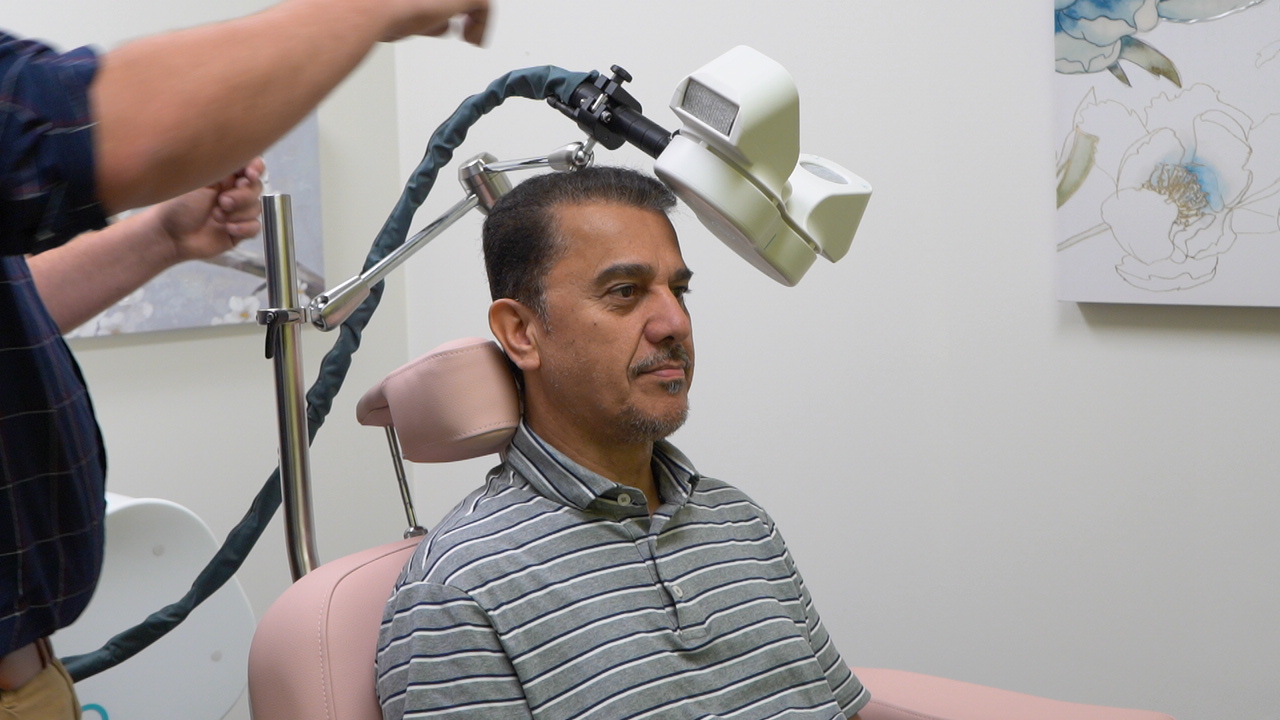
Before treatment begins, clients undergo a mapping session in which providers identify the precise location on the scalp needed to target the appropriate brain region. A magnetic coil is then positioned near the head, delivering pulses to the frontal cortex.
According to TMS Technician Drake Reinke, a Clinical Health Navigator at LFS, who joined LFS after working in neuroscience research, the treatment is designed to reactivate underperforming areas of the brain.
“TMS is a form of treatment where we use magnetic fields to upregulate certain neuronal neighborhoods in the brain,” he said. “It’s completely safe, and it works great for helping treat major depressive disorder.”
Reinke said clinicians typically target a brain region called the dorsolateral prefrontal cortex.
“It’s a region of the brain commonly associated with emotional control,” he explained. “That’s the area we upregulate during treatment.”
Depression can reduce activity in the brain regions responsible for mood regulation, Reinke said. By stimulating those areas, TMS helps restore healthier activity patterns.
“During depression, those parts of the brain are less active,” McGowan said. “This restimulates it and becomes active again.”
A Safe, Non-Invasive Approach
One of the primary advantages of TMS is that it does not require surgery, anesthesia or medication.
“It’s a very safe, non-invasive treatment,” Reinke said. “All they have to wear is a small cap, which we do brain mapping on when they first come in and decide to do TMS.”
Treatment sessions generally occur three to five times per week for four to eight weeks and last approximately 20 to 40 minutes.
Clients remain awake and comfortable during the procedure and can immediately return to normal daily activities afterward.
“They get to go home after the treatment,” Reinke said. “It’s very non-invasive.”
Any side effects are also typically mild, Reinke said.
“The only side effect is that sometimes people might get a tension headache,” he said. “After a week, it typically goes away as the neurons kind of relax and get used to the stimulus.”
An Option for People Who Haven’t Found Relief
TMS is often recommended for individuals who have not responded well to antidepressant medications.
“Typically, it’s used as a form of treatment for people who have found medications don’t work really well for them,” Reinke said. “It’s not a first option, but it’s a third option.”
Many insurance providers require patients to have tried at least two antidepressant medications from different drug classes before becoming eligible for TMS.
For those patients, TMS can offer another opportunity to manage symptoms.
“It’s a nice form of treatment that we can offer our clients,” Drake said. “It’s another route.”
In clinical studies, one in two patients experiences significant improvement in depression symptoms, by using TMS, while about one in three achieves remission.
Bringing Neuroscience to Client Care
Reinke brings a strong neuroscience background to the new program. Before joining LFS, he worked as a research assistant at Boys Town’s Institute for Human Neuroscience.
“I was doing neuroimaging research, looking at pediatrics, looking at brain wave dynamics during development, brain structure and cortical thinning, Alzheimer’s, drug use and HIV,” he said.
A University of Nebraska-Lincoln graduate, Reinke continues to consult with neuroscience startups while helping build the TMS program at LFS.
“It’s a big growing field, and I’m happy to be a part of it,” he said. “This is my bread and butter. I’m glad to be part of the team here and helping build the program out.”
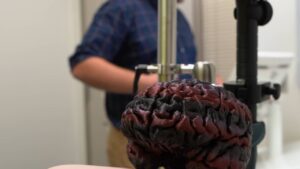
His enthusiasm for neuroscience is evident. He even displayed a life-sized 3D-printed model of his own brain to help explain how TMS works.
Looking Toward the Future
Although LFS is currently launching TMS specifically for depression treatment, research into additional applications continues to expand, and it has already been approved for treatment of OCD.
“It’s one of the only FDA-approved treatments so far,” Reinke said, referring to depression. “But there are also FDA approval studies going on right now for PTSD, bipolar disorder and schizophrenia.”
Researchers across the country are also studying whether neuromodulation technologies like TMS can help treat conditions ranging from stroke recovery to Parkinson’s disease and substance use disorders.
“It’s kind of like a Swiss Army knife because you can use it to activate different brain regions,” Reinke said, of the TMS machine.
For now, LFS is focused on bringing the treatment to clients in Lincoln, where staff are currently accepting new patients.
“We’re currently looking for patients to start doing TMS,” Reinke said.
The organization has its sights set on growth over time.
“We would love to be able to expand ” McGowan said. “Whether it be in Omaha or out in western Nebraska, we want to be able to expand these services.”
As LFS continues to broaden its behavioral health offerings, TMS represents another step toward providing clients with innovative, evidence-based care and more options for finding relief from depression.
Questions or ready to learn more? Contact the Health 360 Integrated Care clinic to talk with your team about whether TMS may be right for you.
Lutheran Family Services
Health 360 Integrated Care Clinic
2301 0 Street
Lincoln NE 68516
402-441-7940